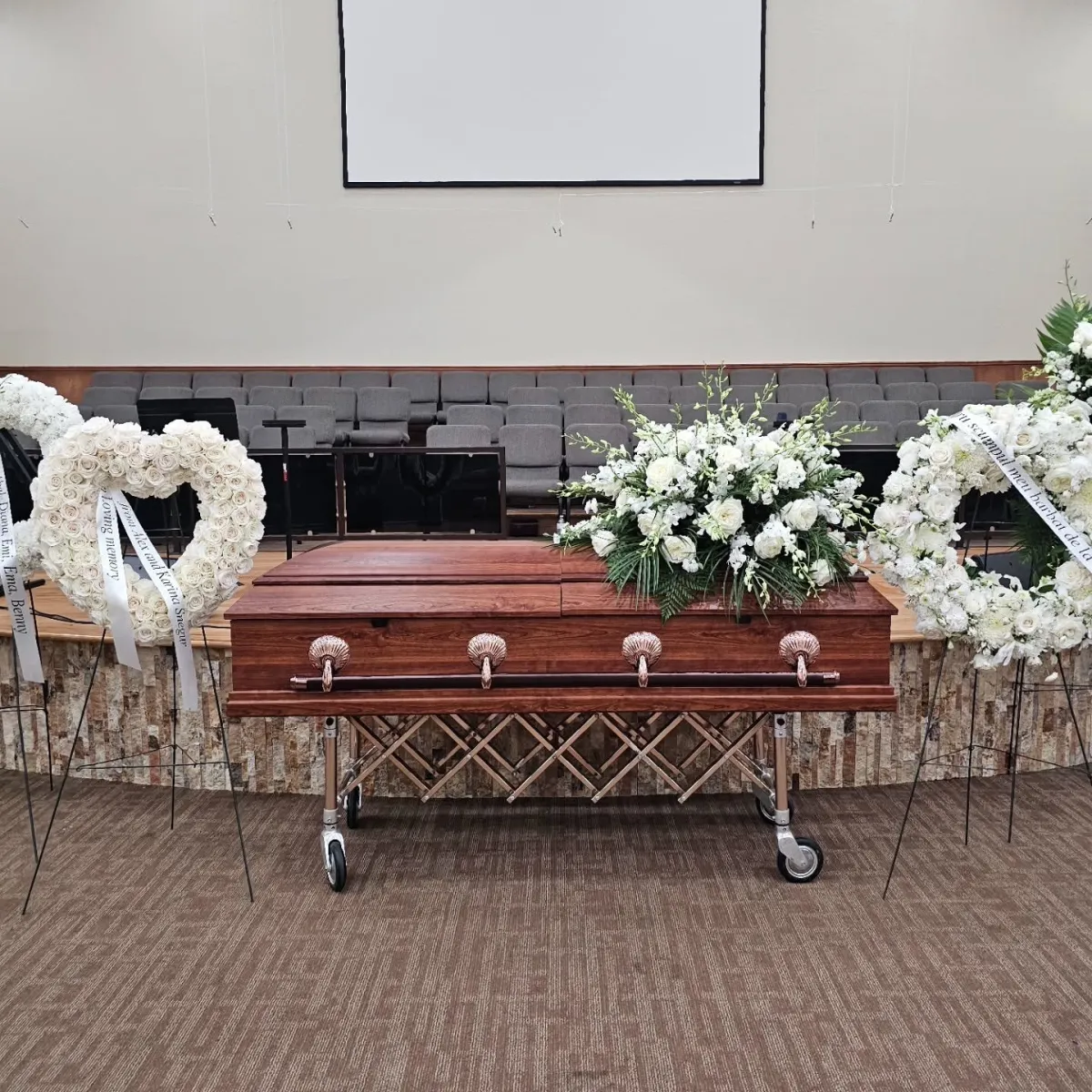
When someone passes, one of the quiet questions nobody wants to ask out loud is: who is supposed to handle the flowers? Is it the spouse's job? The kids? Do friends order their own? Does the funeral home take care of it?
There's no law here, only tradition. But the tradition is consistent enough that we can lay it out clearly. Here is who typically buys what, and what to do in the situations where it isn't obvious.
The Traditional Breakdown by Role
| Who you are | What you traditionally provide |
|---|---|
| Spouse or partner | The casket spray (the centerpiece on the casket) |
| Children of the deceased | The casket spray if there's no surviving spouse, or a large standing piece such as a heart or cross |
| Parents of the deceased | The casket spray when their child has no spouse, or a prominent standing spray |
| Siblings | A standing spray or wreath, often shared between siblings |
| Grandchildren, nieces, nephews | A shared standing piece or a sympathy arrangement |
| Close friends | A standing spray, wreath, or an arrangement sent to the family home |
| Coworkers or organizations | One shared standing spray or a plant, sent on behalf of the group |
The pattern underneath the table is simple: the closer the relationship, the closer the flowers sit to the casket. If you want the fuller picture of what the different pieces are, our guide to casket sprays vs. standing sprays explains each type.
Who Pays for the Casket Spray?
The immediate family. Usually that means the surviving spouse, or the children acting together when there is no spouse. In many Clark County families, adult children split the cost of the casket spray evenly, and one person handles the ordering.
The casket spray is the one piece that should not come from outside the immediate family. Sending one as a friend or distant relative, however well-meant, steps into territory that belongs to the closest survivors.
Does the Funeral Home Provide Flowers?
Generally, no. Funeral homes arrange the service, prepare the casket, and manage the venue, but flowers are ordered separately by the family from a florist. Some funeral homes offer flower packages through a partner shop, and those can be convenient, but you are never required to use them. You're free to order from any florist you choose, and the funeral home will receive the delivery either way.
That choice matters more than most families realize. A florist who works funerals every week knows how pieces need to be sized for a chapel, how they're transported without damage, and when they need to arrive. That's the entire business we run. Our walkthrough of the ordering process shows what it looks like step by step.
When the Family Situation Is Complicated
Traditions assume tidy families. Real families are rarely tidy. A few common situations:
Divorced spouse
An ex-spouse typically does not provide the casket spray. If the relationship remained warm, a standing spray or a sympathy arrangement is a respectful choice. If adult children from that marriage are handling arrangements, the ex-spouse often contributes through them instead.
Blended families
When there's a surviving spouse and adult children from a previous marriage, the casket spray traditionally comes from the spouse, and the children provide their own prominent piece, often a heart. If tensions exist, a shared casket spray with both names on the card can be a gracious middle path.
No immediate family
When the closest survivors are cousins, friends, or a community group, whoever is organizing the service takes on the casket spray decision. There is no rule that says it must be blood family. The piece honors the person; who paid for it matters far less than that it's there.
Estranged relatives
If you were estranged and are unsure whether sending flowers would be welcome, a modest arrangement delivered to the service with a simple, sincere card is rarely wrong. Our guide on what to write on a funeral flower card has wording that works when the relationship was complicated.
How Costs Are Usually Shared
There's no single rule, but these patterns come up constantly in the orders we take:
- Casket spray: paid by the spouse, or split evenly among adult children.
- Family standing pieces: siblings often pool together on one wreath or heart rather than sending several small pieces.
- Friend groups and workplaces: one person collects contributions and places a single order on behalf of the group, with the group named on the card.
Pooling almost always produces a better result. One well-built standing spray from six coworkers looks far more substantial than six small bouquets, and it's easier on everyone. For what full services typically cost, see our post on how much funeral flowers cost in Vancouver WA.
If You're the One Handling It All
Often one person ends up responsible for every floral decision: the casket spray, the family pieces, coordinating who sends what. If that's you, you don't need to arrive with answers. We're a family owned and operated funeral florist in Vancouver, and funeral work is all we do. You tell us about the person and the service, we suggest what fits, and we deliver to funeral homes across Clark County, with on-site setup when your service needs it, all included in the price we quote. Most orders come together with one to two days' notice. If the service is sooner, call and we'll tell you straight away what's possible.
One Detail That Isn't Optional
If you're the one ordering the casket spray, there's a single question you need the answer to before anything gets built: is the casket open or closed?
A full couch spray covers the whole length of the casket and is used when it stays closed. A half couch covers the lower half and is used for an open-casket viewing or service. This isn't a style preference. A full couch spray on an open casket physically doesn't work, and it's not something that can be adjusted on the morning of.
If you don't know, the funeral director does, and so do we — it's the first thing we ask. Nobody expects you to have thought about it.
What to Have Ready When You Call
Whether you call us or anyone else, this is what a florist needs from you:
- The name of the person who died, spelled the way the funeral home has it
- The name of the funeral home, church, or cemetery
- The date and time of the service
- What the card should say, and who it's from
- Your relationship to the family — that tells us what's appropriate
If you don't have all of it, call anyway. Plenty of the orders we take start with someone who only knows a name and a rough date, and the funeral home fills in the rest. If you're not sure whether your flowers should go to the venue or to the family's house, our guide on where to send funeral flowers covers that.
Handling the Flowers for a Service?
Call us and tell us about the service and who's involved. We'll help you sort out what pieces make sense, then call you back with a clear quote, usually within a few hours.
Call (360) 984-8059Prefer to write it out? Fill out our quote form.